Metacognition: how to check you understand, with examples

Metacognition means noticing how you learn and using that knowledge to guide what you do next: planning, monitoring and evaluating your learning. For revision, it means checking whether you can solve or explain something without notes, comparing your attempt with clear criteria, then choosing what to practise next.12
How do you use metacognition when studying?
Start with one task you can check. ‘Understand percentages’ is vague; ‘find the original price after a discount’ gives you something to attempt.
- Plan: What does success require? Choose an approach and predict how confident you are that you will answer correctly.
- Monitor: Attempt the task without notes. Notice where your reasoning breaks down; check whether each step answers the question.
- Evaluate: Compare your answer with a worked solution, mark scheme or explicit checklist. Decide what to change before trying again.
This adapts the plan–monitor–evaluate approach described by the EEF. Its guidance stresses teaching strategies within specific subjects: general reflection still needs relevant subject knowledge.1
The examples below are invented learner responses, not observations of real pupils or evidence of improved results.
Why can understanding feel stronger than it is?
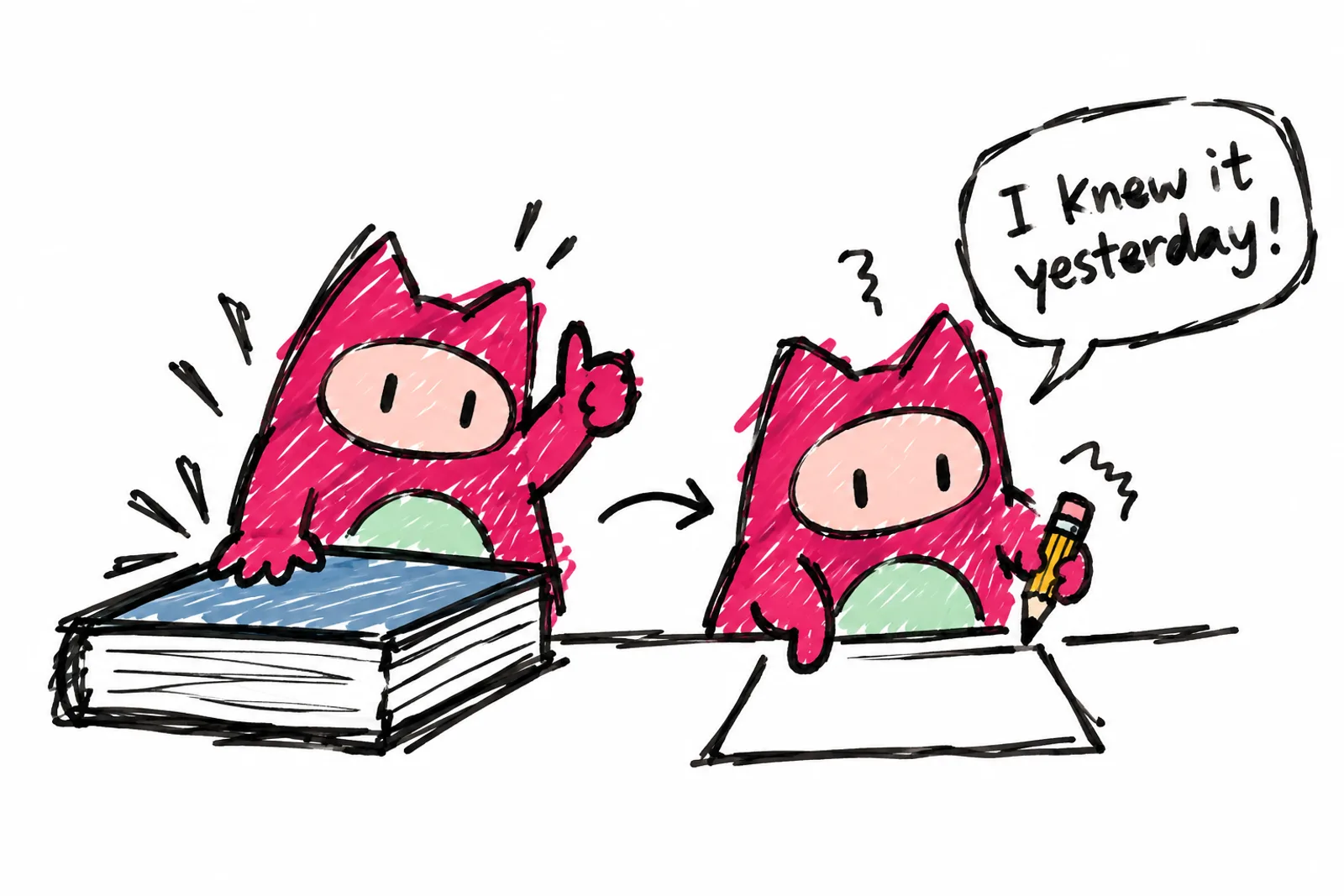
Following a solution with the answer visible is different from producing one yourself. Cornell recommends paraphrasing, testing yourself on questions and recording what remains unclear.2
In two experiments with prose passages, Roediger and Karpicke found that repeated study increased confidence. It also produced better recall after five minutes, but prior testing produced better recall after two days or a week.3
That supports caution about judging later recall from an easy study session. It does not prove that every confident answer is wrong, or that remembering a passage demonstrates full understanding of a subject. Check application as well as recall.
What does a metacognition example look like in GCSE maths?
Task: A jacket costs £48 after a 20% discount. Find the original price.
Plan: ‘I'll work backwards. I'm 90% confident.’ Success requires identifying which price represents 100%, calculating the original price and checking the discount.
First attempt, without notes: ‘20% of £48 is £9.60, so the original price was £57.60.’
Monitor: The arithmetic is correct, but what is that 20% a percentage of? The discount was taken from the original price. The learner has used the sale price instead.
Check: £48 represents 80% of the original, so the calculation is 48 ÷ 0.8 = £60. Applying the discount checks it: £60 × 0.8 = £48. Discounting £57.60 gives £46.08, which fails the check.
Evaluate: ‘I can calculate a percentage, but I confused the starting amount. Next I'll label the original as 100% before choosing a calculation.’
The next step is a different reverse-percentage question. Copying £60 into the notebook repairs this answer; solving a fresh problem checks whether the method has changed.
How can you use metacognition in A-level science?
Task: Explain what stays equal at dynamic equilibrium in a closed reaction mixture under unchanged conditions.
Plan: ‘I'll distinguish reaction rates from concentrations. I'm 80% confident.’ The checklist requires continuing reactions, equal forward and reverse rates, and constant concentrations.
First attempt, without notes: ‘The reaction stops because reactants and products reach equal concentrations.’
Monitor and check: This confuses ‘constant’ with ‘equal’. AQA specifies equal forward and reverse reaction rates and constant reactant and product concentrations.4
Corrected response: ‘Both reactions continue at the same rate. Concentrations remain constant because neither side has a net change; the reactant and product concentrations do not have to equal each other.’
Evaluate: ‘I recognised the phrase dynamic equilibrium but couldn't explain it. I'll redraw concentration–time curves and explain why two different final levels can both be flat.’
Then answer a new question: does adding a catalyst change the equilibrium position? No: AQA explicitly distinguishes its effect on rate from equilibrium position.4
How can you check confidence against performance?
Use the two questions below as a short written exercise. Before answering each, record your confidence from 0% to 100%. Keep the answers hidden, close your notes and show your reasoning. For the maths question, include a forward check; for chemistry, distinguish rates from concentrations.
Answer from memory, then tap a question to check.
1. A bag costs £36 after a 10% discount. What was its original price?
£40. The sale price is 90% of the original, so 36 ÷ 0.9 = 40. Check: 40 × 0.9 = 36. Adding 10% to £36 would give £39.60, which does not reverse the discount.
2. At dynamic equilibrium, must reactant and product concentrations be equal? Explain.
No. The forward and reverse reaction rates are equal, so the concentrations remain constant under unchanged conditions. Constant concentrations need not be equal concentrations.
Now compare each response with its answer. Did high confidence accompany an incorrect method? Did low confidence accompany sound reasoning? Identify the specific step that needs attention, then choose one fresh question to check it.
This is an educational activity, not a validated diagnostic test. Two questions cannot establish your overall metacognitive ability or tell you whether a confidence percentage is well calibrated. Use them to choose a next step for these topics.
How does metacognition help you choose a revision technique?
Let the gap guide the method. If you cannot retrieve a definition, try active recall. If you can state it but cannot apply it, work through an example, explain the decisions and attempt a new problem. If the underlying idea is unclear, return to instruction or ask your teacher.
Our revision techniques guide covers broader study choices. Metacognition supplies the check before choosing among them: what can you demonstrate, what remains uncertain, and what will you do about it?
Can you answer these questions from memory?
Look away from the article. Answer first, then reveal the responses and identify one point to revisit.
Answer from memory, then tap a question to check.
1. What are the three stages of the metacognitive cycle?
Plan a task and approach; monitor your understanding while attempting it; evaluate the evidence and choose your next step.
2. Why did adding 20% to the £48 sale price fail?
The discount was 20% of the original price. Adding 20% of the smaller sale price uses a different base. £48 represents 80% of £60.
3. Why is recognising a worked solution insufficient evidence of understanding?
It does not show that you can produce or apply the reasoning without that solution. Try a fresh question and check against explicit criteria.
4. What should follow a confident error?
Identify the precise error, check the relevant idea against a reliable source, and attempt a new question. Use the result to decide what to study next.
Sources
- Education Endowment Foundation (2025). Metacognition and Self-Regulated Learning. Second edition; published 13 November 2025.
- Cornell University Center for Teaching Innovation (2026). Metacognitive Strategies. Undated teaching guidance; accessed 30 October 2026.
- Henry L. Roediger III and Jeffrey D. Karpicke (2006). Test-enhanced learning: Taking memory tests improves long-term retention. Psychological Science, 17(3), 249–255; abstract and bibliographic record.
- AQA (2026). A-level Chemistry 7405: Physical chemistry. Specification, section 3.1.6; access year, not an asserted publication year.